Platform / Capability
Connect Every System Into One Data Plane
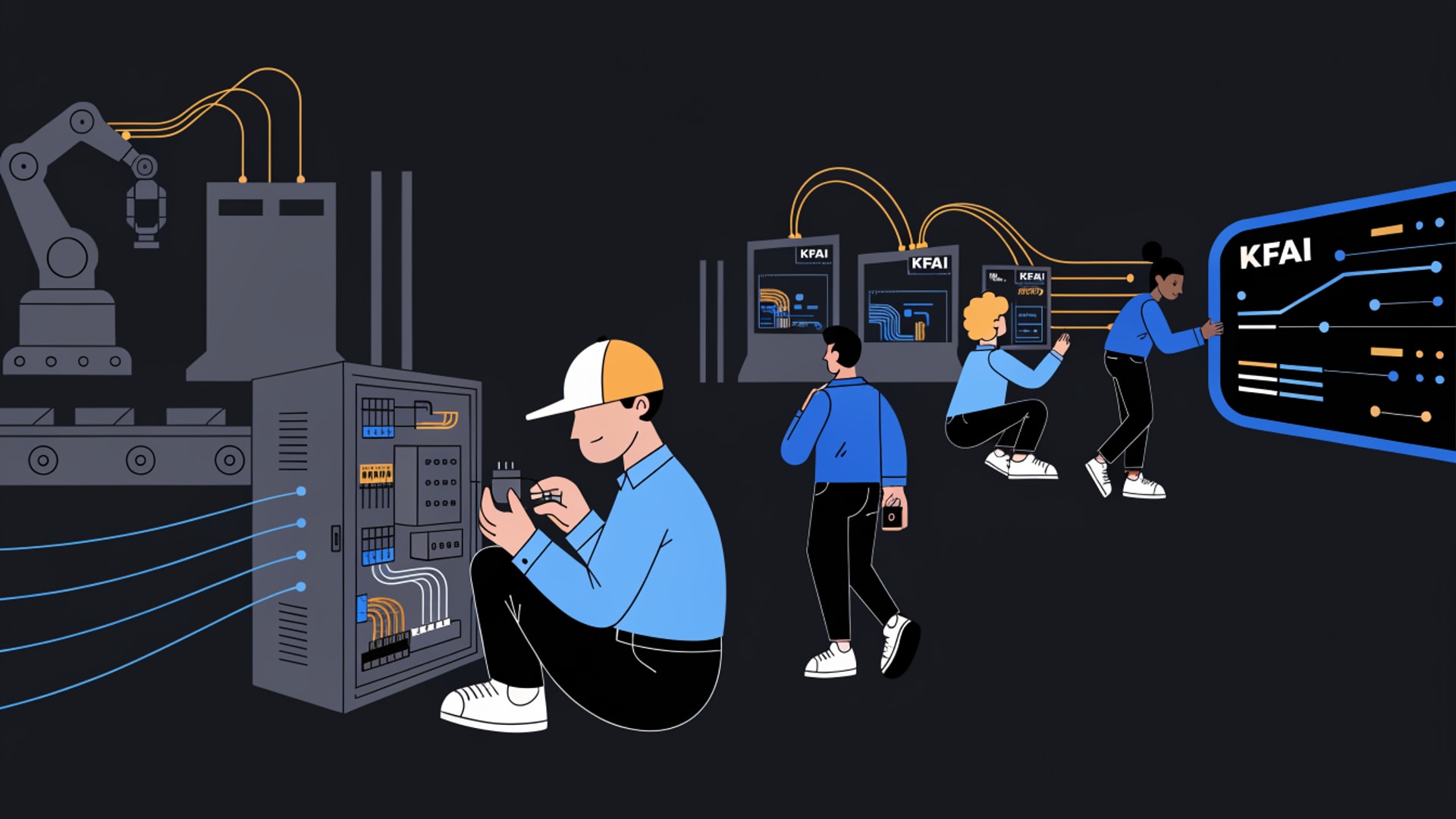
KaizenFlow reads from the systems your plant already runs. Instead of another database to fill, it connects on top of your MES, SCADA, ERP, and historians through 43 pre-built connectors, then unifies the signals into one queryable data plane your teams can actually reason about.
One queryable data plane, not another silo
Most plants do not have a data problem. They have a data access problem. Production counts sit in the MES, tag histories sit in the historian, work orders sit in the ERP, and machine faults sit in the PLC. Each system answers its own narrow question, and none of them talk to each other.
KaizenFlow does not ask you to move that data or standardize it first. It connects to each source in place, maps the tags and fields into a common model, and gives operations, engineering, and finance one place to query across all of it. A downtime event in the historian can finally be joined to the work order that caused it and the dollar value of the units it cost you. This is the foundation the rest of the KaizenFlow platform is built on.
43+ pre-built connectors across your stack
The connector library covers the four layers most manufacturers run. You do not build these from scratch; they ship configured and tested.
- ERP and business systems: SAP, Microsoft Dynamics 365 Business Central, Oracle NetSuite, Oracle E-Business Suite.
- SCADA and historians: OSIsoft PI, Ignition, Kepware, Rockwell FactoryTalk, AVEVA Wonderware, GE Proficy.
- PLC and controls: Rockwell (Allen-Bradley), Siemens TIA Portal, Mitsubishi, Beckhoff, Omron.
- Protocols and transports: OPC-UA, MQTT, Modbus TCP/RTU, and REST for anything with an API.
If a system exposes a supported protocol, it is usually already covered. When something is bespoke, the REST and OPC-UA connectors handle most of the long tail, and any net-new connector is built as part of design-partner onboarding.
No rip-and-replace, live in one to two weeks
KaizenFlow sits on top of your existing systems as a read layer. Nothing gets ripped out, no control logic changes, and your operators keep the HMIs and dashboards they already use.
A typical connection follows three steps:
- Connect: point the connector at the source (an OPC-UA endpoint, a historian server, an ERP instance) using scoped, read-only credentials.
- Map: align the tags, counters, and fields to a shared model so that a good part means the same thing across lines and sites.
- Verify: confirm the numbers reconcile against what your team already trusts before anything is surfaced as an opportunity.
Because there is no hardware to install and no historian to migrate, most single-site connections are live in one to two weeks.
Protocols, read-first, and the long tail
The core industrial protocols do most of the work. OPC-UA covers modern controls and many historians through a secure, typed interface. MQTT handles high-frequency telemetry and edge brokers. Modbus, over TCP and serial, reaches older equipment that predates either. A generic REST connector covers MES modules, LIMS, CMMS, and homegrown systems that expose an API.
By default, connectors are read-only. KaizenFlow is a manufacturing intelligence layer, not a control system, so it observes and analyzes rather than writing back to the floor. That keeps the safety and change-management boundary exactly where your controls team wants it.
How your data is handled
Connections use scoped credentials and least-privilege access. Data is encrypted with TLS 1.3 in transit and AES-256 at rest, and every customer runs inside an isolated multi-tenant boundary.
Our controls and processes are aligned to SOC 2 and ISO 27001 (aligned, not yet certified), and our own site analytics use Plausible, which is cookieless and stores no personal data. If your security team needs to review the integration model before anything connects, that review is a normal part of onboarding.
What connected data actually unlocks
Integration is the means, not the point. Once the systems are joined into one plane, KaizenFlow's ensemble of nine AI specialists can rank every improvement opportunity by dollar impact and confidence, measured against fundamentals like OEE and TEEP, and reconcile the results into a verified savings ledger your finance team signs off on.
That closed loop only works when the data is connected first. The design-partner program models target ranges of 8 to 18 percent unplanned downtime reduction, 5 to 12 percent scrap reduction, 4 to 11 percent throughput gain, and 3 to 7 percent energy reduction. These are modeled ranges, not results we claim on your behalf, and every figure is checked against your own reconciled numbers.
Frequently asked
Do I have to replace my MES, SCADA, or historian? No. KaizenFlow connects on top of the systems you already run and reads from them in place. Nothing is ripped out, and your operators keep their existing HMIs and dashboards.
How long does a connection take? Most single-site connections are live in one to two weeks. There is no hardware to install and no historian to migrate, so the timeline is driven by credentialing and tag mapping rather than infrastructure.
What if my system is not on the connector list? The generic OPC-UA and REST connectors cover most of the long tail. For genuinely bespoke systems, building a net-new connector is part of the design-partner onboarding process.
Can KaizenFlow write back to my controls or PLCs? By default, no. Connectors are read-only. KaizenFlow is a manufacturing intelligence layer that observes and analyzes; it does not send commands to the floor.
Is my production data secure? Data is encrypted with TLS 1.3 in transit and AES-256 at rest, and each customer runs in an isolated tenant. Our controls are aligned to SOC 2 and ISO 27001.
Can we export our raw data or pull it through an API? Yes, on every plan. Your data is yours: metrics, events, and the savings ledger can be exported or read over the API for use in your own BI tools. On exit, you get a full data export - that is written into our terms, not buried in a sales deck.
Own your output
See what connecting your plant reveals
Bring your stack. We will map the connectors, reconcile the numbers, and show you where the dollars are hiding.