Solutions / Industry
Manufacturing intelligence for building materials
Cement, aggregates, glass, gypsum, and brick share one economic truth: the plant lives or dies on energy per ton, tons per hour, and the reliability of a few very large assets. KaizenFlow connects to the systems you already run and turns those pressures into ranked, verified savings.
Why building-materials plants are their own problem
A building-materials plant runs on a different set of physics than a discrete factory. The product is heavy and low-margin per ton, the process is hot and continuous, and a handful of very large assets set the ceiling for the whole site. When a kiln, a float furnace, a raw mill, or a primary crusher slows down, nothing downstream can make up the difference.
That shapes where the money is. In cement and glass, energy is often the single largest controllable cost, and it is spent turning raw material into product at 1400 degrees C and above. In aggregates and gypsum, the plant is throughput-bound: every ton per hour you cannot push through the crusher, mill, or dryer is margin you never book. Quality sits on top of both, because an out-of-spec result in a continuous process is expensive to catch and painful to rework.
- A few critical assets (kiln, furnace, mill, crusher, dryer) that gate the entire plant.
- Energy intensity measured in kWh and thermal units per ton of product.
- Continuous or near-continuous operation, where one unplanned stop cascades.
- Quality tied directly to process parameters like fineness, moisture, and composition.
Where the loss hides, by process
The losses worth an engineer's hour are rarely the loudest ones. They are the slow drifts and the recurring minor stops that a monthly report averages away. Here is where they tend to hide across the main building-materials processes:
- Cement: kiln availability and thermal upsets, raw-mill and cement-mill electrical draw, free-lime and Blaine fineness excursions, and preheater or ID-fan issues that force a rate cut.
- Aggregates: primary and secondary crusher blockages, screen blinding, conveyor and belt faults, and tramp-metal stops that pull tons per hour below plan.
- Glass: pull-rate limits, furnace and forehearth temperature drift, and defects such as seeds, stones, and cord that turn a continuous ribbon into cullet.
- Gypsum: calciner and board-line dryer energy, line-speed limits, and edge or bond defects that scrap finished board.
- Brick and block: dryer and tunnel-kiln fuel, firing-curve drift, and cracking or color variation that scraps fired product.
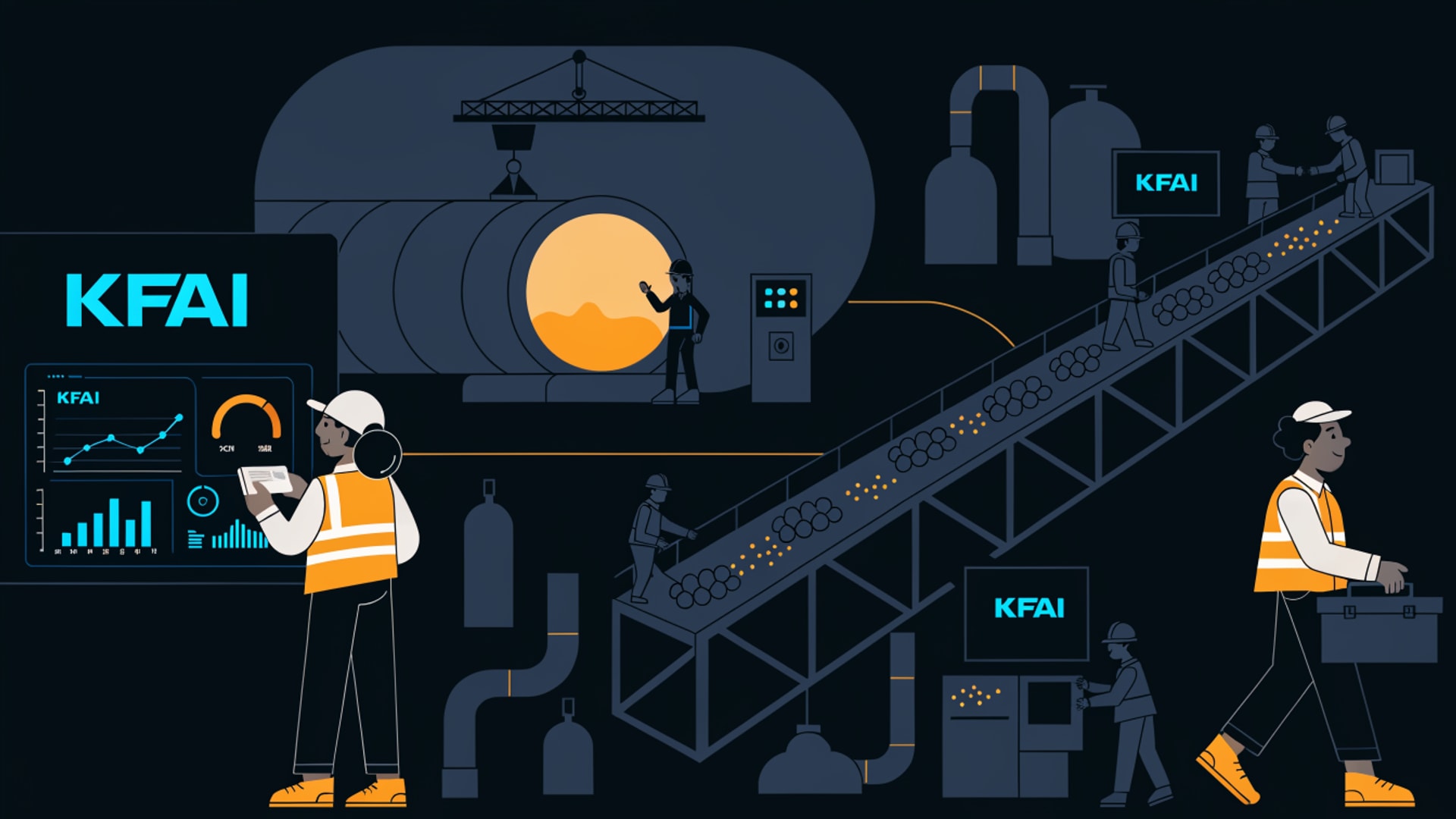
Energy per ton is the number that runs the plant
For most building-materials sites, energy per ton is the number that runs the plant. Specific energy consumption, measured in kWh per ton of product and in thermal units per ton of clinker or fired product, is both the biggest cost line and the clearest signal that something has drifted. A grinding circuit pulling more kWh per ton than last quarter, or a kiln burning more fuel per ton of clinker, is telling you about wear, control, or feed quality before any alarm does.
KaizenFlow's Energy Optimizer normalizes consumption against production and product mix, so you compare like with like across shifts, lines, and sites rather than reacting to a raw meter reading. It separates the energy loss you can act on (a fan running against a throttled damper, a mill past its optimal fill, a kiln with an unstable burn) from the load you cannot. If you want the underlying method for turning these losses into a dollar, our OEE and TEEP guide walks through the framework.
One unplanned stop can erase a quarter of gains
In a continuous process, reliability is not only a maintenance concern, it is a production and energy concern. A rotary kiln or a float furnace cannot simply be switched off and on. An unplanned kiln stop carries hours of reheating and lost production, burns fuel to recover temperature, and can put clinker quality at risk on restart. One avoided major stop can be worth more than a month of incremental gains everywhere else.
The Reliability Forecaster watches the large rotating assets (the kiln, mills, crushers, and fans) for the slow signatures that precede a failure, while the Anomaly Sentry flags process deviations in real time from your historian. The goal is to convert an unplanned stop into a planned intervention on your terms. Across the design-partner program, KaizenFlow models an 8 to 18 percent reduction in unplanned downtime as a target range, always measured against your own baseline and never presented as a result you already own.
One closed loop: connect, surface, decide, verify
KaizenFlow is manufacturing intelligence, not another system to rip and replace. It runs one closed loop on top of the plant you already operate.
Connect. KaizenFlow reads from your existing MES, SCADA, ERP, and historians through 43+ connectors, including SAP, Siemens, Rockwell, OSIsoft PI, Ignition, Kepware, OPC-UA, MQTT, and Modbus. It is read-only and never sits in the control path of your kiln, furnace, or line.
Surface and decide. An ensemble of nine AI specialists, among them the Energy Optimizer, Throughput Analyst, Quality Sentry, Reliability Forecaster, and Schedule Strategist, ranks every improvement opportunity by dollar impact and confidence. Your team works the costliest, most certain fix first instead of the loudest alarm.
Verify. The Savings Auditor reconciles each fix against a normalized baseline and rolls the result into a verified savings ledger your finance team signs. You can see the whole loop on the platform overview.
What an eight-week pilot looks like
A pilot runs about eight weeks on one plant. We connect to your systems, model the closed loop against a real asset (a kiln line, a grinding circuit, a crushing and screening train, or a furnace) and hand back a ranked opportunity list with a verified savings figure your controller can check.
We are honest about numbers because we are a design-partner-stage company with no customers to name yet. The ranges we model from the program are targets, not achievements: 8 to 18 percent less unplanned downtime, 4 to 11 percent more throughput, 3 to 7 percent lower energy per ton, and 5 to 12 percent less scrap. Each is measured against your own baseline, and the opportunities that do not hold do not go in the ledger.
Your data stays protected throughout: TLS 1.3 in transit, AES-256 at rest, and strict multi-tenant isolation, with the program aligned to SOC 2 and ISO 27001. You can read the specifics on our security page.
Frequently asked
Do we have to replace our SCADA, historian, or DCS? No. KaizenFlow sits on top of the systems you already run and connects through 43+ connectors such as OSIsoft PI, Ignition, Rockwell, Siemens, OPC-UA, and Modbus. It is read-only and never sits in the control path, so most sites are streaming data within days.
How do you measure energy per ton reliably? The Energy Optimizer reads from your meters and historian, then normalizes consumption against production volume and product mix. That lets you compare energy per ton fairly across shifts, lines, and sites instead of reacting to a raw meter reading that moves with the schedule.
Our kiln or furnace cannot stop for a trial. Is that a problem? No. The pilot is read-only and observes your process through existing systems. Nothing KaizenFlow does touches the control path of a kiln, furnace, mill, or crusher, so there is no operational risk to a continuous line.
What results should we expect? We model target ranges from our design-partner program rather than quoting customer results we do not have: 8 to 18 percent less unplanned downtime, 4 to 11 percent more throughput, 3 to 7 percent lower energy per ton, and 5 to 12 percent less scrap, each measured against your own baseline.
How is our production data secured? Data is encrypted with TLS 1.3 in transit and AES-256 at rest, with strict multi-tenant isolation. The program is aligned to SOC 2 and ISO 27001, and site analytics run on Plausible, which is cookieless and stores no personal-data cookies.
Building materials - eight-week pilot
See it on your plant.
Book a walkthrough and we will model the closed loop against one of your real assets: a kiln, grinding circuit, crushing train, or furnace. You get the ranked opportunities and the verified savings figure your controller can sign.