Compare / Augury vs MachineMetrics
Augury vs MachineMetrics
Augury and MachineMetrics get cross-shopped all the time, and they almost never should be. One asks whether a machine is about to fail. The other asks what a machine produced. This page lays out what each does well, how to choose between them, and a third question neither of them asks.
Disclosure: this comparison is published by KaizenFlow, which competes in the adjacent manufacturing-intelligence space. We are not neutral, so we have written this the only way a non-neutral party credibly can: both vendors get a fair treatment, every claim traces to their public materials, and KaizenFlow's own pitch is confined to one clearly labeled section near the end.
Augury vs MachineMetrics at a glance
The two companies appear in the same software searches and often on the same shortlist, which is understandable: both put hardware on machines, and both promise fewer surprises from production equipment. It is also misleading, because they barely compete head-on. Augury is a machine-health platform. It exists to tell you that a bearing, gearbox, or motor is developing a fault before it fails. MachineMetrics is a machine-monitoring platform. It exists to tell you what your CNC and discrete machines produced, how utilized they were, and why they stopped.
Diagnosis versus measurement is the real split, and it matters more than any feature table. A plant that buys Augury expecting OEE dashboards will be disappointed, and a plant that buys MachineMetrics expecting bearing-fault diagnostics will be equally so. If you arrived here comparing either tool against KaizenFlow instead, we keep a direct KaizenFlow vs Augury page and a full library of comparison pages.
What Augury does
Augury is built around machine health and reliability. Its approach pairs purpose-built sensing, such as vibration, acoustic, and temperature sensors mounted on rotating equipment, with AI diagnostics tuned to detect developing faults. The target problems are mechanical: a bearing starting to wear, a gearbox running rough, a motor drifting out of balance on a critical pump, fan, or compressor.
The value case is strongest where a surprise failure is expensive and the plant's existing instrumentation is too thin to see the fault coming. In that situation, adding a dedicated signal at the machine is often the only way to get the early warning, and Augury's combination of sensing and AI diagnostics reflects serious reliability domain depth. Augury also extends into process health beyond individual assets.
What MachineMetrics does
MachineMetrics, founded in 2014 and based in Massachusetts, started as CNC machine monitoring and has climbed the stack since. Its core method is an edge device wired into the machine control itself, speaking protocols like MTConnect, OPC UA, and Fanuc FOCAS, with direct integrations for Haas, Okuma, Mazak, and what its connectivity materials describe as thousands of makes and models. That control-level connection feeds automated production tracking: machine status, utilization, OEE, downtime categorization, part-specific cycle times, and job tracking, without relying on operator self-reporting.
Today it positions as an "Intelligent MES" for discrete manufacturers, with bi-directional ERP integration (Oracle, SAP, Infor, Dynamics 365, Sage X3), labor tickets, projected job completion, and drag-and-drop scheduling, plus a recently introduced agentic AI layer called Max AI. Its heritage and customer base are overwhelmingly discrete metal-cutting: aerospace, medical devices, automotive, and contract machining, with named customers including Fastenal and Paragon Medical.
Different questions
The cleanest way to keep the two straight is to name the question each one answers. Augury answers a machine-health question: will this machine fail, and what is wrong with it? MachineMetrics answers a machine-monitoring question: what did this machine produce, and where did the time go? Both are legitimate questions, and answering either one well is hard engineering.
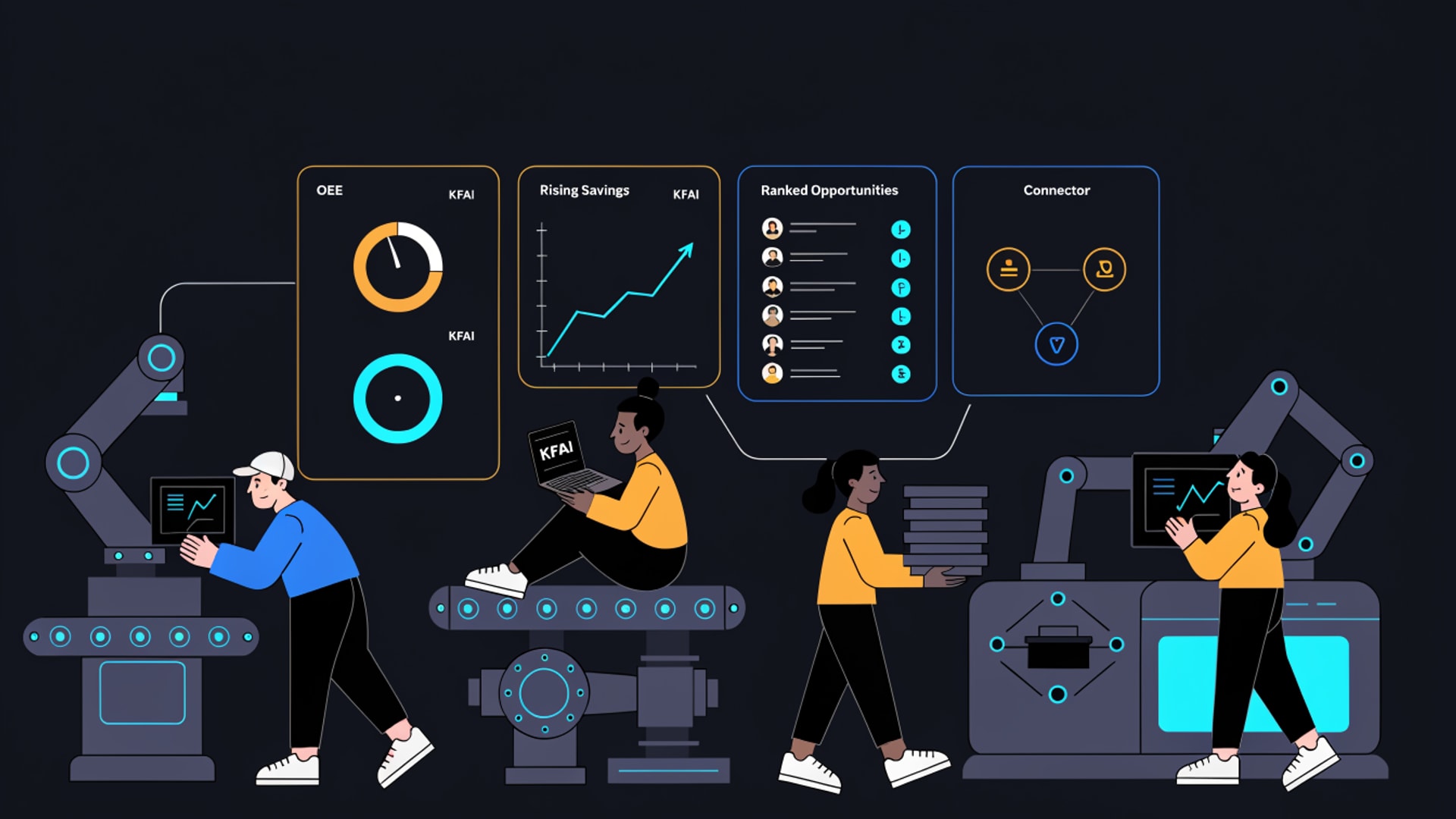
There is also a third question that neither tool is built to answer: across the whole plant, which loss costs the most money, and did the fix actually pay back? That is a plant-economics question. It is the one KaizenFlow exists for, and since this is our page, it appears in the diagram below with our name on it, clearly marked.
Where Augury is strong
Judged on its own question, Augury is genuinely good, and it deserves a fair account of why.
- Real depth in machine-health diagnostics. Purpose-built vibration, acoustic, and temperature sensing paired with AI diagnostics is a strong combination for catching a bearing, gearbox, or motor problem while it is still early.
- It works where existing data cannot. On a critical pump, fan, or compressor with thin instrumentation, the plant's existing signals often cannot see a developing mechanical fault. A dedicated sensor at the machine can.
- The economics fit critical assets. Where a single surprise failure is expensive, early warning on that one machine can justify the sensing on its own.
- It reaches beyond single assets. Augury also extends into process health, so the machine-health depth is not a dead end.
If unplanned mechanical failure on rotating equipment is your dominant pain, Augury is a strong and appropriate choice, and nothing else on this page changes that.
Where MachineMetrics is strong
MachineMetrics is equally credible on its own question, and its strengths compound in CNC and discrete environments.
- Control-level data fidelity. Because the edge device connects to the machine control itself, the data is automated and high-fidelity rather than self-reported, which is the foundation everything else rests on.
- A connectivity moat. A decade of protocol and driver work (MTConnect, OPC UA, Fanuc FOCAS, direct Haas and Okuma integrations, and more) covering thousands of makes and models per its connectivity materials is hard to replicate.
- More than a dashboard. The Intelligent MES tier adds bi-directional ERP integration, job and production-order tracking, labor tickets, and scheduling, and the Max AI layer points at AI-guided execution.
- Buyer-friendly mechanics. Unlimited users on every plan, self-install edge kits, and public hardware list prices lower the friction of getting started machine by machine.
- Recognizable discrete customers. Named customers and case studies concentrate exactly where the product's DNA is: metal-cutting job shops, aerospace, medical devices, and automotive.
If your plant runs CNC or discrete production and the pain is utilization, downtime reasons, and schedule execution, MachineMetrics is the category default for good reason.
How to choose between them
Choose by the problem, not by the category label.
- If the pain is unplanned mechanical failure on critical rotating assets, and existing instrumentation cannot see the faults coming, choose Augury. That is the machine-health problem, and dedicated sensing is the honest answer to it.
- If the pain is CNC or discrete utilization, OEE visibility, downtime reasons, and job tracking, choose MachineMetrics. That is the machine-monitoring problem, and control-level data collection is the honest answer to it.
- If both pains are real, the two can coexist. They monitor different things in different ways and do not step on each other.
One structural fact should inform any budget conversation: both products are hardware-led. Augury installs sensors on each asset it monitors. MachineMetrics connects an edge device or adapter kit to each machine, with public hardware list prices of roughly $1,300 to $1,500 per Edge kit plus accessories where needed. Both scale their cost per monitored unit, and neither publishes software pricing, so total cost comes from a vendor quote. None of that is a criticism; it is simply how per-machine hardware models work, and it means the economics improve or worsen with the number of machines you cover.
The third option: KaizenFlow
Everything above stands on its own. This section is where the publisher pitches itself, and we label it as exactly that.
KaizenFlow answers the plant-economics question from the diagram: which loss costs the most, and did the fix pay back? It does so without new hardware. Instead of adding sensors or edge devices, the platform reads the SAP, PLC, SCADA, and MQTT signals your plant already produces. Nine AI specialists (Anomaly Sentry, Throughput Analyst, Quality Sentry, Energy Optimizer, Reliability Forecaster, Schedule Strategist, Yield Modeler, Maintenance Planner, and Savings Auditor) rank downtime, scrap, energy, and throughput losses by dollar and carbon impact, so the improvement list is ordered by money rather than by alarm count. Results land in a savings ledger that separates modeled estimates from verified results and is signed by your own finance team. Pricing is published: a pilot runs $25k-$75k, and Pro runs $5k-$15k per month.
The honest caveat, since this page has been honest so far: if your plant has little or no existing data infrastructure, KaizenFlow's ingestion story is weaker, and the hardware-led approaches above are a legitimate answer rather than a workaround. Our fit is plants that already generate data nobody is monetizing. If that sounds like yours, the pilot program is the fastest way to test the claim, and it ends with a verified before/after savings report.
About this comparison
This comparison is published by KaizenFlow AI, which competes in the adjacent manufacturing-intelligence space and pitches its own product in the clearly labeled section above. We have aimed for a fair treatment of both vendors: their strengths are stated plainly, their facts come from their public materials, and our commercial interest is disclosed rather than hidden.
The page reflects publicly available information as of July 2026. Product capabilities, pricing, and packaging change often, so readers should verify current details directly with each vendor before making a decision. Augury, MachineMetrics, and all other third-party names and marks are trademarks of their respective owners. Reference here indicates comparison only, and implies no affiliation, sponsorship, or endorsement.
Frequently asked
What is the difference between Augury and MachineMetrics? Augury is a machine-health platform: purpose-built vibration, acoustic, and temperature sensing on rotating equipment, with AI diagnostics that catch developing mechanical faults early. MachineMetrics is a machine-monitoring platform: an edge device connected to the machine control that feeds OEE, utilization, downtime, and job tracking for CNC and discrete production. One predicts whether a machine will fail; the other measures what a machine produced.
Do Augury and MachineMetrics require hardware? Yes, both are hardware-led. Augury installs vibration sensors on the assets it monitors, and MachineMetrics connects an edge device or adapter kit to each monitored machine, per their public materials. If your plant already streams usable data through PLC, SCADA, or MQTT systems, it is worth asking whether you need new hardware at all.
How much does MachineMetrics cost? MachineMetrics does not publish software pricing. Its site describes a volume-based per-machine subscription with unlimited users, with hardware sold separately at public list prices, as of July 2026. Check current pricing directly with the vendor.
Can Augury and MachineMetrics be used together? Yes. They cover different questions and can coexist, with Augury watching the health of critical rotating assets while MachineMetrics measures production on CNC and discrete machines. Both can also feed a plant-economics layer that ranks the resulting losses in dollars and verifies what each fix returned.
Is there an alternative that needs no new hardware? KaizenFlow, the publisher of this page, is a software-only option: it reads the SAP, PLC, SCADA, and MQTT signals a plant already produces, ranks downtime, scrap, energy, and throughput losses by dollar and carbon impact, and verifies savings in a finance-signed ledger. It answers a different question than either tool above, and this answer is our pitch as well as our disclosure.
The third question
Know which loss costs the most before you buy hardware
KaizenFlow reads the signals your plant already produces, ranks losses by dollar and carbon impact, and ends an eight-week pilot with a before/after savings report your finance team signs.