Compare / L2L
KaizenFlow vs L2L
L2L and KaizenFlow both show up in conversations about connected manufacturing operations, but they answer different questions. L2L is a system of action that runs daily work: maintenance dispatch, work orders, production, and frontline skills. KaizenFlow is an intelligence and verification layer that reads the signals your plant already emits, ranks every loss by dollar and carbon, and proves what the fixes returned.
KaizenFlow vs L2L at a glance
Put side by side, the two products read like answers to different questions, because they are. L2L, originally Leading2Lean, is a Connected Manufacturing Operations platform: a system of action that runs daily work on the floor. It grew out of CloudDISPATCH, a “911 dispatch for the factory floor,” and today spans maintenance dispatch and CMMS/EAM, production management (MES), OEE monitoring, and skills management with digital work instructions. Per L2L's announcement, in April 2026 it added Execution AI, nine pre-configured prescriptive “Solvers” centered on machine analysis, preventive maintenance, and operational availability.
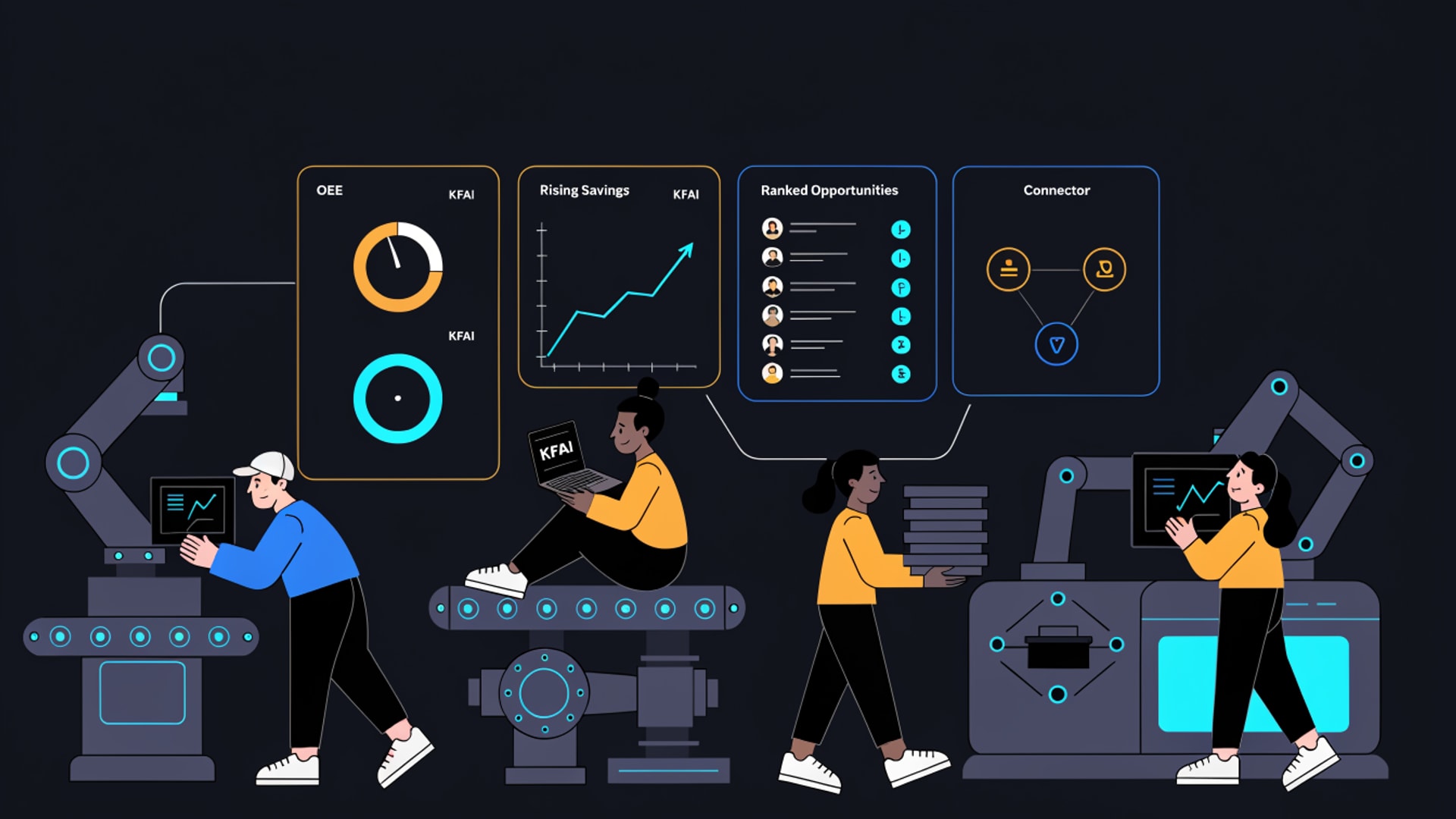
KaizenFlow is an intelligence and verification layer. It ingests the signals your ERP, PLCs, SCADA, and MQTT streams already emit, ranks every loss - downtime, scrap, energy, throughput - by dollar and carbon impact, and reconciles the results into a verified-savings ledger your own finance team signs. One runs the work. The other tells you which work is worth the most money and proves what it returned. That difference is the whole point of this page, and it matters more than any feature-by-feature table would suggest.
A system of action and a verification layer
The cleanest way to think about it: L2L operates at the point of action, and KaizenFlow operates at the point of decision. They are not competing answers to the same question.
- L2L: detect a disruption in real time, dispatch the right person, guide the fix with visual instructions and asset history, log the resolution, and keep skills and SOPs current - a genuinely closed loop on downtime and maintenance.
- KaizenFlow: ingest signals from ERP, PLCs, SCADA, historians, and MQTT streams through connectors like SAP, Siemens, Rockwell, OSIsoft PI, Ignition, and OPC-UA, then rank every improvement opportunity by dollar and carbon impact and verify the return.
A plant running L2L generates exactly the kind of structured downtime and maintenance data an intelligence layer loves to read. KaizenFlow does not dispatch anyone or manage a work order, and L2L does not exist to reconcile a finance-signed savings number across energy, scrap, and throughput. You can see how the analytics layer connects on the integrations page and how it works end to end on the platform overview.
Where L2L is strong
If your problem is running maintenance and daily work at scale, L2L is a strong answer and worth taking seriously. It has spent more than fifteen years hardening a system of action for exactly that job.
- A real closed loop on downtime and maintenance: detect the disruption, dispatch the right person, guide the resolution, and analyze failures centrally. The 911-dispatch heritage still shows, in a good way.
- Scale and proof: L2L reports 500,000+ users across 93 countries, with blue-chip manufacturers publishing quantified case studies on downtime, OEE, maintenance dollars, and training time.
- An integrated platform: dispatch, CMMS/EAM, MES, OEE monitoring, and skills management with digital work instructions in one place, following its Stabilize, Standardize, Optimize improvement loop.
- A reputation for fast implementation - go-live in as little as a few weeks - and consistently strong reviews for frontline usability and configurability.
If your primary need is running maintenance dispatch, work orders, and frontline skills day to day, L2L is a credible system of action, and KaizenFlow is not a CMMS or MES. We would rather say that plainly than pretend an intelligence layer replaces the systems that run the work.
Where KaizenFlow is different
KaizenFlow is built for a different question: of everything that could be improved across the plant, what is worth doing first, and did the change actually pay off? Three things make that concrete against L2L specifically.
- The full loss spectrum, not one slice. L2L's loop is genuinely closed on downtime and maintenance, and its Execution AI Solvers are centered there. KaizenFlow puts downtime, scrap, energy, and throughput losses on one list, ordered by money rather than by module.
- Dollar and carbon together. Every loss is scored in dollars and in carbon, so energy waste competes for attention on the same list as a bottleneck. Energy and carbon are not part of L2L's published outcomes at all.
- Modeled versus verified. An ensemble of nine AI specialists (Anomaly Sentry, Throughput Analyst, Quality Sentry, Energy Optimizer, Reliability Forecaster, Schedule Strategist, Yield Modeler, Maintenance Planner, and Savings Auditor) scores each opportunity by estimated dollars and confidence, and results are reconciled into a before/after ledger your own finance team signs. That modeled-versus-verified distinction has no equivalent in L2L's case-study framing.
Modeled targets from our design-partner program illustrate the range we build toward: 8 to 18 percent lower unplanned downtime, 5 to 12 percent less scrap, 4 to 11 percent higher throughput, and 3 to 7 percent less energy. These are modeled targets, not results from named customers, and we say so on every page. The mechanics of the ledger are described on the savings ledger page.
How they work together
Because they sit on different layers, L2L and KaizenFlow can be genuinely complementary rather than mutually exclusive.
- L2L runs the work: real-time dispatch, work orders, guided resolutions, and the skills and SOPs that keep the frontline consistent.
- KaizenFlow reads the plant's signals - including the structured downtime and maintenance data a system like L2L produces - ranks every loss by dollar and carbon impact, and verifies the savings once you act. Its findings can be handed to whichever system of action will do the work.
In that arrangement, the system of action executes and the intelligence layer decides and proves. It also covers ground L2L's public positioning does not emphasize: energy and carbon losses get dollarized and ranked alongside everything else, so sustainability stops being a separate report and starts competing for the same attention as downtime. Neither one has to lose for the other to be useful.
Which one you actually need
A simple way to choose, without overselling either tool:
- If your primary pain is running maintenance dispatch, work orders, production, and frontline skills day to day, start with a system of action. L2L is a credible choice, and KaizenFlow is not a substitute for it.
- If your primary pain is that you cannot see where the biggest losses are in dollar or carbon terms, or you cannot prove that improvement projects paid back, that is the problem KaizenFlow was built to solve.
- If both are true, the two can coexist, with L2L running the work and KaizenFlow ranking the money and verifying the return.
Fit matters too. L2L is built for mid-market to enterprise, multi-plant operations, and its pricing is sales-led with no public tiers as of July 2026 - we keep a full L2L pricing guide with what is public and what to ask in the sales call. KaizenFlow goes live on your data in one to two weeks and is reachable for a single-line SMB plant - the pilot program is designed for exactly that, and it ends in a verified before/after savings report. If you want to weigh that motion against other tools, see our other comparison pages or talk to us about a pilot.
About this comparison
This comparison reflects KaizenFlow's view based on publicly available information as of July 2026. Product capabilities change, and vendors update their offerings often, so readers should verify current details directly with each vendor before making a decision. All third-party names and marks, including L2L and Leading2Lean, are trademarks of their respective owners. Reference here indicates comparison only, and implies no affiliation, sponsorship, or endorsement.
Frequently asked
Is KaizenFlow an L2L alternative? For loss ranking and verified savings, yes. If you need to know where the money is leaking across downtime, scrap, energy, and throughput, and prove what the fixes returned, KaizenFlow is the right category. It is not a CMMS or MES replacement: KaizenFlow does not dispatch maintenance, manage work orders, or run production the way L2L does.
How much does L2L cost? L2L does not publish pricing. As of July 2026 there are no public tiers or numbers on l2l.com; pricing is sales-led with custom quotes, and there is no self-serve trial. Contact L2L directly for a current quote.
Does KaizenFlow do maintenance dispatch or work orders? No. KaizenFlow ranks losses by dollar and carbon impact and verifies the savings once you act. It can hand its findings to the systems that run the work, including platforms like L2L, but it does not replace them.
Does L2L track energy or carbon? L2L's published outcomes center on downtime, OEE, maintenance, and training time; energy and carbon are not part of its public pitch. KaizenFlow ranks every loss by dollar and carbon impact, so energy waste competes for attention on the same list as downtime and scrap.
How fast does KaizenFlow go live? Typically one to two weeks on your data, with an eight-week pilot that ends in a verified before/after savings report.
See the closed loop
Find your biggest losses before you buy anything
KaizenFlow connects on top of the systems you already run, ranks losses by dollar and carbon impact, and ends the pilot with a before/after savings report your finance team signs.