Compare / Guidewheel
KaizenFlow vs Guidewheel
Guidewheel and KaizenFlow go after the same money - the losses hiding on your plant floor - from opposite directions. Guidewheel clips a sensor on every machine and reads its electrical draw. KaizenFlow installs no hardware: it reads the SAP, PLC, SCADA, MQTT, and CSV signals your plant already emits, ranks every loss by dollar and carbon, and verifies the savings with your finance team.
KaizenFlow vs Guidewheel at a glance
This is the closest head-to-head comparison on this site. Both products promise plant-floor intelligence for manufacturers, and both lead with AI. The first fork in the road is how the data gets in. Guidewheel's wedge is non-invasive clip-on CT sensors that read each machine's electrical draw: live data in minutes, hardware included in the subscription, and no integration with PLCs or ERP required. KaizenFlow's wedge is the opposite: it installs nothing, and instead ingests the signals your plant already produces - SAP and other ERPs, Siemens S7 PLCs, SCADA, MQTT brokers, even CSV exports.
The second fork is what happens after something is detected. Guidewheel is monitoring: dashboards, alerts, OEE tracking, and a data flywheel that compounds the longer you run it. KaizenFlow is a closed loop: detect, recommend, assign, verify - ending in a savings ledger your finance team signs. Which fork matters more depends entirely on the plant you run, and the rest of this page is about helping you decide that honestly.
Two paths to plant data
Strip away the branding and there are exactly two ways to get machine data: add hardware that creates new signals, or read the signals that already exist.
- Guidewheel: clip a CT sensor onto each machine's power feed and read its electrical heartbeat. It works on any age, make, or model of equipment, needs no PLC or ERP integration, and delivers live data in minutes - one sensor per machine, included in the subscription.
- KaizenFlow: connect to the systems the plant already runs - SAP and other ERPs, Siemens S7 PLCs, SCADA, MQTT brokers, CSV exports - and read the richer signals they already emit. Nothing to buy, clip on, or maintain.
We will say the honest part plainly. If your plant has almost no digital infrastructure - older machines, no PLCs worth reading, no ERP data - clip-on sensing is genuinely the faster start, and Guidewheel is a credible choice. But if you already run SAP, Siemens PLCs, or an MQTT broker, buying and maintaining a sensor for every machine duplicates data your plant already emits, and an electrical-draw curve is a thinner signal than the process, quality, and order data sitting in those systems. The full connector list is on the integrations page.
Where Guidewheel is strong
Guidewheel earned its position, and pretending otherwise would make this page useless. Four things it does genuinely well:
- Fastest time-to-value where no data infrastructure exists. If your machines emit no digital signals, a clip-on sensor delivers live data in minutes, with no integration project and no dependency on the state of your systems.
- Simple to quote. The sensor hardware is included in the subscription, so there is no separate hardware line item to negotiate - one number covers devices and platform.
- Scale and trust. Guidewheel reports 500+ manufacturers, including Fortune 500 logos, which is real social proof for a buyer who needs the safe choice.
- Support that reviewers consistently praise. Public reviews repeatedly call out responsive, excellent customer service alongside ease of use.
If your floor is mostly older machines with nothing to read, that is a genuinely strong package, and Guidewheel is a credible place to start. We would rather tell you that plainly than force-fit a data-ingestion story onto a plant that has no signals to ingest.
Where KaizenFlow is different
KaizenFlow is built on a different bet: most plants already emit more signal than they use, and the hard part is not collecting more data but turning what exists into ranked, verified money. Four differences follow from that.
- No new hardware. KaizenFlow ingests SAP and other ERPs, Siemens S7 PLCs, SCADA, MQTT, and CSV exports. Nothing is clipped on and nothing has to be maintained, and the signal is richer than a power curve: process parameters, quality events, and order and cost context, not just electrical draw.
- A closed loop, not a dashboard. Guidewheel's product is monitoring, alerts, OEE, and a data flywheel. KaizenFlow runs detect, recommend, assign, verify - every detected loss becomes a recommended action, an owner, and a before/after result in a savings ledger your finance team signs.
- Measurement honesty. Guidewheel's public outcomes are headline percentages. KaizenFlow separates modeled from verified savings. Modeled targets from our design-partner program illustrate the range we build toward: 8 to 18 percent lower unplanned downtime, 5 to 12 percent less scrap, 4 to 11 percent higher throughput, and 3 to 7 percent less energy. These are modeled targets, not results from named customers, and we say so on every page.
- Dollar and carbon, first class. Guidewheel began in energy management; its public positioning now leads with FactoryOps. KaizenFlow ranks every loss by dollar and carbon as a first-class surface, so the plants that report on energy and emissions do not have to bolt that on later.
The mechanics of the loop are described on the platform overview.
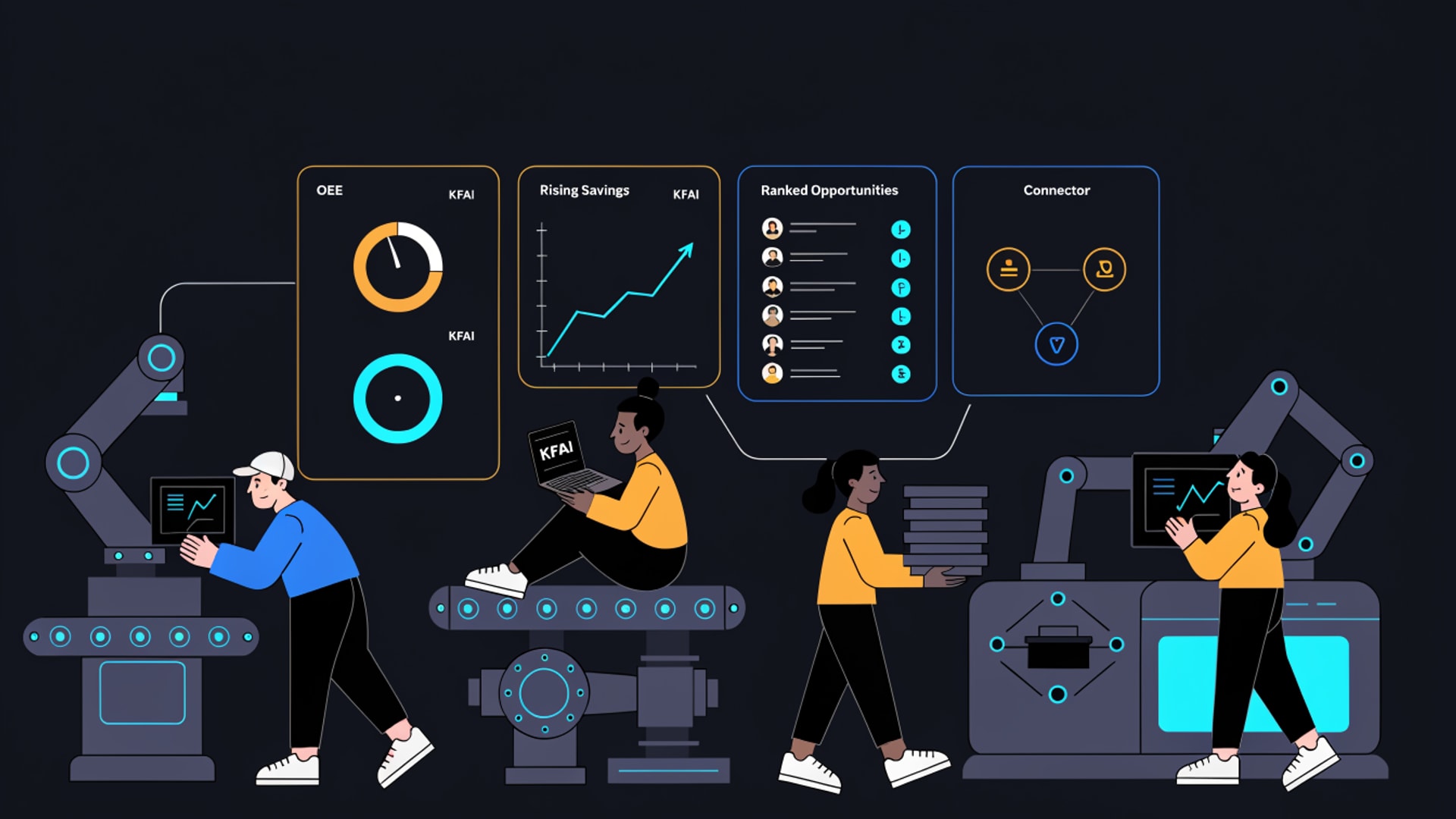
How they work together
Because they solve different halves of the problem - creating signals versus deciding what the signals are worth - the two can coexist in the same plant without either one losing.
- Guidewheel can cover the machines that emit nothing: older standalone equipment with no PLC gets a clip-on sensor, and its readings become one more stream of machine data.
- KaizenFlow can read those sensor readings alongside ERP, PLC, and SCADA data, rank the resulting losses by dollar and carbon, assign the fixes, and verify the savings in the ledger.
In that arrangement the sensors fill gaps in coverage and the intelligence layer turns the combined data into a prioritized, finance-verified plan. Mixed estates are common; a comparison page that pretends otherwise is selling, not helping.
Which one you actually need
A simple way to choose, without overselling either tool:
- If your plant has almost no digital infrastructure - older machines, no PLCs worth reading, no ERP data - clip-on sensing is the faster start, and Guidewheel is a credible choice. KaizenFlow needs signals to read.
- If your plant already runs SAP, Siemens PLCs, SCADA, or an MQTT broker, buying and maintaining a sensor for every machine duplicates data you already emit. KaizenFlow reads that data directly, with no hardware step at all.
- If your primary pain is proving that improvements paid off - to a plant manager, a CFO, or a board - the closed loop and the finance-signed ledger are the specific things KaizenFlow was built for, and monitoring alone will not get you there.
- If both are true, the two can coexist: sensors on the silent machines, ingestion everywhere else, and one ranked, verified plan on top.
On cost: as of July 2026, per their public pricing page, Guidewheel starts at $15,000 per year for the first 10 machines, scales per machine beyond that, and includes the sensor hardware - the full breakdown is in our Guidewheel pricing guide. KaizenFlow is priced for a single-line plant; the pilot program page explains how the eight-week engagement works. To weigh other tools, see our comparison pages or talk to us.
About this comparison
This comparison reflects KaizenFlow's view based on publicly available information as of July 2026. Product capabilities change, and vendors update their offerings often, so readers should verify current details directly with each vendor before making a decision. All third-party names and marks are trademarks of their respective owners. Reference here indicates comparison only, and implies no affiliation, sponsorship, or endorsement.
Frequently asked
Is KaizenFlow a Guidewheel alternative? Yes, specifically the no-new-hardware alternative. KaizenFlow reads the SAP, PLC, SCADA, MQTT, and CSV signals your plant already emits instead of clipping a sensor on every machine, then ranks losses by dollar and carbon and verifies the savings. If your plant has almost no digital signals to read, Guidewheel's clip-on sensors are a reasonable place to start.
Does KaizenFlow require sensors or new hardware? No. KaizenFlow installs no hardware. It connects to the systems you already run, including SAP and other ERPs, Siemens S7 PLCs, SCADA, MQTT brokers, and even CSV exports, and turns those signals into a ranked, finance-verified improvement plan.
How much does Guidewheel cost? As of July 2026, Guidewheel's public pricing page lists a starting price of $15,000 per year for the first 10 machines, with per-machine scaling beyond that and the sensor hardware included in the subscription. KaizenFlow is priced for a single-line plant; the pilot program page explains the engagement.
Can KaizenFlow and Guidewheel work together? Yes. For machines that emit no digital signals, Guidewheel's clip-on sensor readings can become one more input that KaizenFlow reads alongside ERP, PLC, and SCADA data to rank losses by dollar and carbon and verify the savings.
How fast does KaizenFlow go live? Typically one to two weeks on your data, with an eight-week pilot that ends in a verified before/after savings report.
See the closed loop
Find your biggest losses before you buy hardware
KaizenFlow installs no sensors. It connects on top of the systems you already run, ranks losses by dollar and carbon, and ends the pilot with a before/after savings report your finance team signs.