Compare / Tractian
KaizenFlow vs Tractian
Tractian and KaizenFlow both promise fewer surprises on the plant floor, but they answer different questions. Tractian mounts wireless vibration and temperature sensors on your machines and uses AI to catch developing mechanical failures early. KaizenFlow installs nothing, reads the signals your plant already emits, ranks every loss by dollar and carbon impact, and verifies the savings.
KaizenFlow vs Tractian at a glance
Tractian is a hardware-plus-software platform for predictive maintenance and condition monitoring. Its pitch is direct: protect your operations and cut unplanned downtime by detecting failures early, with sensors and AI built for the shop floor, and a CMMS to turn each detection into a work order. It publicly claims 1,500 U.S. and global manufacturers, displays logos like McKesson, Air Liquide, Whirlpool, Verizon, and Cummins, and carries Forbes AI 50, ISO 27001, ISO 9001, and G2 leader badges.
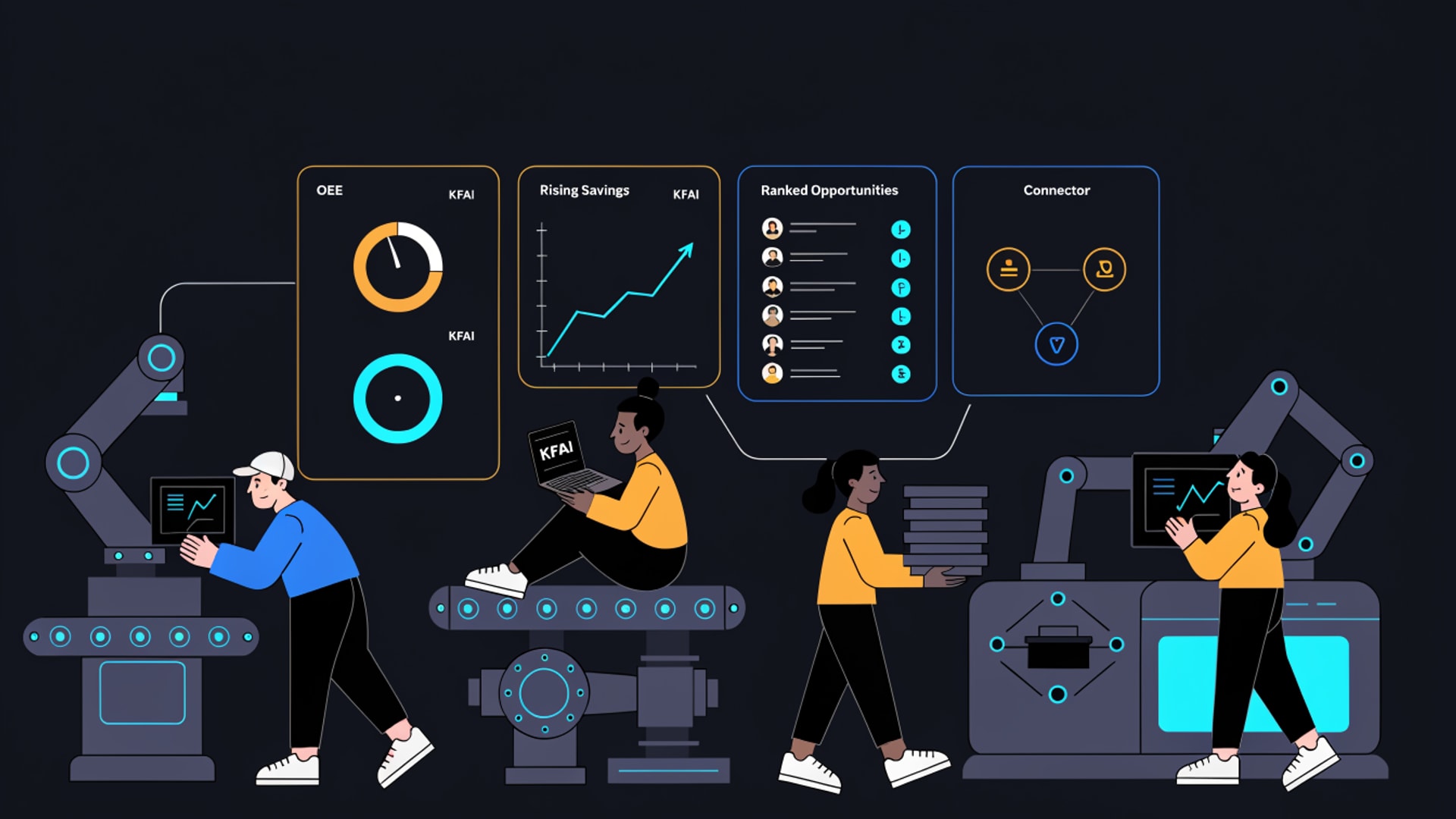
KaizenFlow is a manufacturing intelligence layer. It connects on top of the systems you already run - SAP and other ERP data, PLC and SCADA signals, MQTT streams, even CSV exports - and turns them into a ranked, dollar-weighted list of where to improve, closed with a finance-signed savings ledger. One product asks whether a specific machine is developing a fault. The other asks which of everything wrong in the plant costs the most money and carbon, and whether the fix actually paid back. That difference matters more than any feature table.
Machine health vs plant economics
The cleanest way to hold the two products in your head is by the question each one answers.
- Tractian answers a machine-health question: is this machine developing a fault? Sensors on critical and rotating equipment feed AI models that flag failure modes early, and the built-in CMMS routes the finding into a work order.
- KaizenFlow answers a plant-economics question: of everything wrong in this plant, what costs the most money and carbon, and did the fix actually pay back? An ensemble of nine AI specialists reads your existing signals across downtime, scrap, energy, and throughput, ranks each opportunity by dollars and confidence, and reconciles the results into a verified ledger.
We should be plain about the hardware trade. Tractian's value rides on installing its sensors per asset, and for critical rotating equipment with no instrumentation, purpose-built vibration sensing catches mechanical failure modes that existing PLC and ERP signals may not. Tractian is a credible, well-regarded answer there. KaizenFlow installs nothing and reads what the plant already emits, and it has its own predictive maintenance surface that works from those existing signals. The rest of what it sees - quality, energy, throughput, scheduling - lives outside a sensor's field of view. The full picture is on the platform overview.
Where Tractian is strong
If your problem is critical machines failing without warning, Tractian is a strong answer and worth taking seriously. Its core competency is machine-health depth: purpose-built sensing plus AI, with the follow-through to act on what it finds.
- Sensor-grade failure detection on critical assets. Wireless vibration and temperature sensors catch mechanical failure modes that a plant's existing PLC and ERP signals may never surface, especially on uninstrumented rotating equipment.
- An integrated CMMS and work-order system, so a detection becomes a scheduled, tracked repair inside one command center rather than an alert that dies in an inbox.
- A large installed base and blue-chip trust markers: a claimed 1,500-plus U.S. and global manufacturers, logos including McKesson, Air Liquide, Whirlpool, Verizon, and Cummins, a Forbes AI 50 listing, ISO 27001 and ISO 9001 badges, and a strong G2 review presence.
- Public pricing transparency. Tractian publishes a pricing calculator on its site, which is genuinely good for buyers and rare in this category. Credit where due.
- A very large education engine: glossaries, calculators, and guides on vibration analysis, condition monitoring, OEE, and work orders that many maintenance teams learn from whether or not they buy.
If the core need is sensor-based condition monitoring of critical rotating equipment, Tractian is the right category and KaizenFlow is not a substitute for it. We would rather say that plainly than pretend a software layer replaces a vibration sensor on an uninstrumented gearbox.
Where KaizenFlow is different
KaizenFlow is built for the question that starts one level up from any single machine: of everything wrong in this plant, what is worth fixing first, and did the fix actually pay back? Three things make that concrete.
- No new hardware. KaizenFlow installs nothing and reads what the plant already emits - SAP and other ERP data, PLC and SCADA signals, MQTT streams, even CSV exports. Where Tractian's value rides on mounting sensors per asset, KaizenFlow's rides on connecting to signals you already own, including a predictive maintenance surface built from those existing signals.
- Breadth across the whole loss spectrum. An ensemble of nine AI specialists (Anomaly Sentry, Throughput Analyst, Quality Sentry, Energy Optimizer, Reliability Forecaster, Schedule Strategist, Yield Modeler, Maintenance Planner, and Savings Auditor) scores opportunities across downtime, scrap, energy, and throughput by estimated dollars, carbon, and confidence, so the list is ordered by money rather than by alarm count.
- A verified savings ledger. Results are reconciled into a before/after ledger that your own finance team signs, which closes the loop from connect to surface to decide to verify. The mechanics are on the savings ledger page.
Tractian is deep on machine health; KaizenFlow is broad on plant economics. Modeled targets from our design-partner program illustrate the range we build toward: 8 to 18 percent lower unplanned downtime, 5 to 12 percent less scrap, 4 to 11 percent higher throughput, and 3 to 7 percent less energy. These are modeled targets, not results from named customers, and we say so on every page.
How they work together
Because they answer different questions, Tractian and KaizenFlow can be genuinely complementary rather than mutually exclusive.
- Tractian's condition alerts can feed KaizenFlow's loss ranking as one signal among many. A developing bearing fault becomes an entry in the same dollar-ranked queue as a scrap spike, an energy drift, and a throughput bottleneck, weighed against them by cost rather than by loudness.
- KaizenFlow can quantify whether the maintenance program's savings actually landed. Condition monitoring promises avoided downtime; the verified ledger is how you show finance the before/after number instead of an estimate.
In that arrangement, the sensors deepen signal coverage on the assets that need it most, and the intelligence layer turns everything - sensor alerts included - into a prioritized, finance-verified plan. Neither one has to lose for the other to be useful.
Which one you actually need
A simple way to choose, without overselling either tool:
- If your primary pain is critical rotating equipment failing without warning and those machines carry no instrumentation, start with sensor-based condition monitoring. Tractian is a credible choice there, and KaizenFlow is not a substitute for it.
- If your primary pain is that you cannot see where the biggest losses are in dollar and carbon terms, or you cannot prove that improvement projects paid back, that is the problem KaizenFlow was built to solve - and it starts from the signals you already have, with no hardware to mount.
- If both are true, the two can coexist, with the sensors watching machine health and the intelligence layer ranking every loss and verifying the savings.
On price, Tractian publishes a calculator on its own site, so you can get a current number directly from them. KaizenFlow's entry path is a pilot: live on your data in one to two weeks, ending after eight weeks in a verified before/after savings report. To weigh that motion against other tools, see our other comparison pages or talk to us.
About this comparison
This comparison reflects KaizenFlow's view based on publicly available information as of July 2026. Product capabilities change, and vendors update their offerings often, so readers should verify current details directly with each vendor before making a decision. All third-party names and marks are trademarks of their respective owners. Reference here indicates comparison only, and implies no affiliation, sponsorship, or endorsement.
Frequently asked
Is KaizenFlow a Tractian alternative? For plant-wide loss intelligence and verified savings, yes. For sensor-based vibration monitoring of critical rotating assets, Tractian is the right category, not KaizenFlow. Tractian answers whether a machine is developing a fault; KaizenFlow answers which losses across the plant cost the most and whether the fixes actually paid back.
Does KaizenFlow require sensors? No. KaizenFlow installs no hardware. It reads the signals your plant already emits, including SAP and other ERP data, PLC and SCADA signals, MQTT streams, and even CSV exports, and turns them into a dollar-ranked, verified improvement plan.
How much does Tractian cost? Tractian publishes a pricing calculator on its own site, which is genuinely rare and buyer-friendly in this category, so check it for current numbers. KaizenFlow's entry path is a pilot on your data.
Can KaizenFlow and Tractian work together? Yes. Condition-monitoring alerts from sensors can become one input among many to KaizenFlow's dollar-ranked loss picture, and KaizenFlow can verify whether the maintenance program's savings actually landed.
How fast does KaizenFlow go live? Typically one to two weeks on your data, with an eight-week pilot that ends in a verified before/after savings report.
See the closed loop
Find your biggest losses before you mount a single sensor
KaizenFlow connects on top of the systems you already run, ranks losses by dollar and carbon impact, and ends the pilot with a before/after savings report your finance team signs.