Compare / KaiNexus
KaizenFlow vs KaiNexus
KaiNexus and KaizenFlow both show up when you search for continuous improvement software, but they are two different architectures. KaiNexus is the established system of record for human-driven improvement programs: people capture ideas, run them through configurable workflows, and track the impact. KaizenFlow is continuous improvement on autopilot: it reads the data your plant already produces, detects the losses itself, and verifies the savings in a ledger your finance team signs.
KaizenFlow vs KaiNexus at a glance
Both products live under the continuous improvement banner, which hides how differently they work. KaiNexus, founded in 2009, is an improvement system of record. People across the organization capture ideas and opportunities, move them through configurable workflows built on methodologies like A3, PDSA, DMAIC, Kanban, Standard Work, and Strategy Deployment, and log the resulting impact on each improvement record. It is the management system for a human-driven CI program, and it has spent seventeen years becoming very good at that. KaizenFlow starts from the other end. It ingests the signals your plant already emits - SAP and other ERP data, PLC and SCADA tags, MQTT streams, even plain CSV exports - and an ensemble of nine AI specialists detects the losses, ranks them by dollar and carbon impact, and verifies the savings in a finance-signed ledger.
One architecture is built around what people notice. The other is built around what the data shows. That distinction matters more than any feature-by-feature table would, and it is the honest frame for the rest of this page.
Two loops for continuous improvement
The cleanest way to see the difference is to follow each loop from start to finish.
- KaiNexus: someone on the floor or in a huddle notices an opportunity and captures it as an idea. The idea moves through a configurable workflow with approvals and visual management boards, and the team logs the impact - cost savings, hours saved, revenue - on the improvement record.
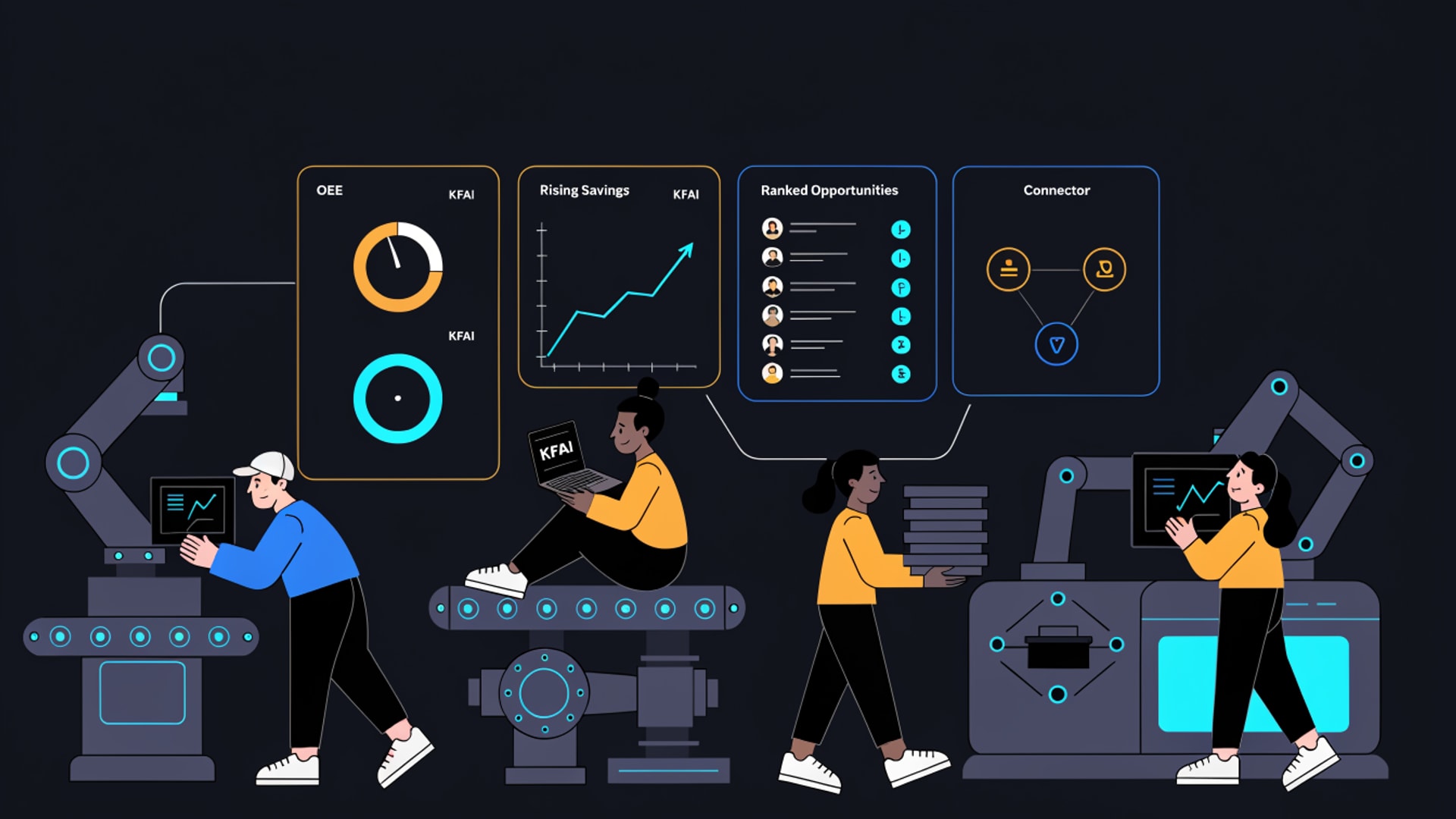
- KaizenFlow: plant data streams in through connectors for SAP and other ERP systems, PLC and SCADA layers, MQTT, and CSV. Nine AI specialists detect and rank the losses by dollar and carbon impact, and the results land in a verified savings ledger your finance team signs.
Both loops are legitimate continuous improvement, but they answer different failure modes. A system of record asks people to type the savings in; KaizenFlow reads them off the line. Neither loop replaces the other, and as we cover below, the strongest plants may eventually run both. The data-driven loop is described in full on the platform overview.
Where KaiNexus is strong
KaiNexus has been doing this since 2009, and the track record shows. If your need is managing a human improvement program at scale, it is a serious, established answer that deserves a straight assessment.
- A seventeen-year track record as a system of record for continuous improvement, with a reference base that runs deep in healthcare and multi-site enterprises, and a public impact story built on more than two million logged improvements and projects, by its own count.
- Methodology breadth in one configurable system: A3, PDSA, DMAIC, Kanban, Standard Work, Strategy Deployment, huddles, and visual management boards, all under one roof, with the flexibility reviewers consistently highlight.
- Customer success that reviewers praise as consistently as any feature, from a vendor that visibly applies continuous improvement to its own product.
- A durable, founder-led company, which is a genuine feature when you are buying a system of record you expect to keep for a decade.
If the need is one management system for methodology, engagement, and impact tracking across a large human CI program, KaiNexus is the established choice in that architecture, and KaizenFlow is not a substitute for it. We would rather say that plainly than pretend otherwise.
Where KaizenFlow is different
KaizenFlow is built for a different starting point: not what people notice, but what the data shows. Three things make that concrete.
- Ingestion is the core product. KaizenFlow connects to SAP and other ERP systems, PLC and SCADA layers, MQTT streams, and plain CSV exports out of the box. In KaiNexus, API access is a separately priced add-on, and reviewers name cross-system data integration as a pain point - less a flaw than a consequence of an architecture whose records are created by people rather than machines.
- Detection and ranking by an ensemble of nine AI specialists, which score every loss by estimated dollars, carbon, and confidence, so the improvement queue is ordered by financial impact rather than by whichever ideas happened to be captured.
- Verified, not just logged. KaiNexus impact figures are logged by the teams doing the work on their improvement records, with deeper ROI tracking available as a paid add-on. KaizenFlow separates modeled savings from verified savings by design, and every result lands in a before/after ledger your finance team signs.
Modeled targets from our design-partner program illustrate the range we build toward: 8 to 18 percent lower unplanned downtime, 5 to 12 percent less scrap, 4 to 11 percent higher throughput, and 3 to 7 percent less energy. These are modeled targets, not results from named customers, and we say so on every page. The mechanics of the ledger are described on the savings ledger page.
How they work together
Because the two loops start from different places, they can genuinely reinforce each other rather than compete.
- A plant can keep running its human CI program in a system of record: the huddles, the boards, the A3s, and the recognition that keeps a culture of improvement alive.
- KaizenFlow can feed that program with detected, dollar-ranked findings - a scrap pattern on one line, an energy drift on the compressors - each arriving with an estimated value attached, ready to become an improvement record.
- When the fix lands, KaizenFlow measures the before and after, so the program's impact numbers rest on verified data rather than estimates alone.
In that arrangement the human loop supplies judgment, ownership, and follow-through, and the data loop supplies detection and proof. Neither one has to lose for the other to be useful.
Which one you actually need
A simple way to choose, without overselling either tool:
- If you are running a large human improvement program - notably in healthcare or across a multi-site enterprise - and need one management system for methodology, engagement, and impact tracking, KaiNexus is the established choice, and KaizenFlow is not a substitute for it.
- If you are a manufacturer who wants the losses found, dollarized, and verified from the plant data you already have - especially a single-line SMB plant without a CI department to staff a program - that is the problem KaizenFlow was built to solve, and our pilot program is designed for exactly that.
- If both are true, the two can coexist, with the system of record managing the program and KaizenFlow feeding it detected, dollar-ranked, verified findings.
KaizenFlow goes live on your data in one to two weeks, and an eight-week pilot ends in a verified before/after savings report. If you want to weigh that motion against other tools, see our other comparison pages or talk to us about a pilot.
About this comparison
This comparison reflects KaizenFlow's view based on publicly available information as of July 2026. Product capabilities change, and vendors update their offerings often, so readers should verify current details directly with each vendor before making a decision. All third-party names and marks are trademarks of their respective owners. Reference here indicates comparison only, and implies no affiliation, sponsorship, or endorsement.
Frequently asked
Is KaizenFlow a KaiNexus alternative? They are two different architectures for continuous improvement. If you want data-driven loss detection and verified savings in manufacturing, yes, that is what KaizenFlow does. If you need to manage a human CI program and its methodologies at scale, KaiNexus is the established category and KaizenFlow is not a substitute for it.
Does KaizenFlow support A3, DMAIC, or PDSA workflows? No. KaizenFlow is not a methodology-management tool. It detects losses from plant data, ranks them by dollar and carbon impact, and verifies the savings. Those findings can feed an A3, DMAIC, or PDSA program rather than replace it.
How much does KaiNexus cost? KaiNexus prices by custom per-user quote, with capabilities such as API access and advanced ROI tracking sold as separately priced add-ons, per their public pricing page as of July 2026. Verify current pricing with KaiNexus directly.
Can KaizenFlow and KaiNexus work together? Yes. KaizenFlow's detected, dollar-ranked findings can become improvement records in a system of record like KaiNexus, so the human program works from data-verified priorities while KaizenFlow measures and verifies the savings once fixes land.
How fast does KaizenFlow go live? Typically one to two weeks on your data, with an eight-week pilot that ends in a verified before/after savings report.
See the closed loop
Find your biggest losses before you buy anything
KaizenFlow connects on top of the systems you already run, ranks losses by dollar impact, and ends the pilot with a before/after savings report your finance team signs.